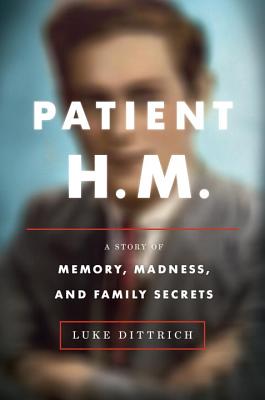
The story of patient H. M. is so important in the history of neuroscience that generally speaking any account about him is worth reading. This book is no exception, although a few important considerations must be mentioned at the outset. First, and most significantly, it turns out that this book is less about patient H. M. than some key people related to his condition. Notable examples include William Scoville, the neurosurgeon that removed H. M.’s medial temporal lobes; Suzanne Corkin, one of the researchers that most thoroughly studied H. M.’s memory deficits; and Jacopo Annese, the neuroanatomist tasked with sectioning and digitizing H. M.’s post mortem brain. This book is really about them (and a few others), whom we get to know well through the eyes of the author, with H. M. serving as the rich backdrop. As such, the book’s title is somewhat inappropriate. On the other hand, its subtitle is more accurate, but still misleading. It turns out that the “memory, madness and family secrets” do not refer to H. M., but rather, the author. You see, Luke Dittrich is William Scoville’s grandson, and it is from this personal perspective that the book gets penned.
Cogently written, the reader will not struggle to get through this book. However, the more traditional, straightforward scientific narrative will not be found here. The author has a tendency to intersperse the storyline with personal anecdotes, family stories, and other digressions that might have literary value, but ultimately detract from the main story. Additionally, the author has a narrow-minded view of scientific and medical history. For instance, he struggles to accept the surgical procedure used to treat H. M.’s underlying epilepsy, which by today’s standards is brutal (a lobotomy), but by the standards of the time was considered reasonable. Basically, Dittrich recounts the past using a modern lens, which is unfair, particularly when he implies a moral equivalency between the atrocities of past careless human experimentation and the primitive but honest attempts to help patients with neuropsychiatric disorders. Nevertheless, these shortcomings aside, there is value to be had in this book, with the reader gaining a deeper insight into the history of patient H. M. In any case, writing this book was likely a cathartic exercise for the author, who obviously grappled with skeletons in his family’s closet, and we cannot deny him that.